
Executive Summary: Key Takeaways
- Diagnose Decision Architecture Failures: Underperforming direct yields are rarely traffic issues; poor conversion and low booking values stem from cognitive overload that pushes guests to OTAs or entry-level rates.
- Audit Three Core Funnel Phases: Systematically evaluate choice architecture (limiting tier clutter), cognitive anchoring (rate display order), and checkout friction (staged micro-commitments) to protect margins.
- Protect Direct Yields & Prevent Defaulting: Clearly justify rate premiums with experiential copy and smart anchors, giving guests the structural clarity needed to select higher-tier rooms and covers.
Understanding Hospitality Booking Behaviour
When hotel owners and food and beverage directors examine underperforming direct revenue, the instinctive response is almost always tactical. They call for refreshed photography, demand higher digital advertising spend, or urge their teams to launch tactical discount codes across social media.
These interventions treat the symptom while actively ignoring the pathology. In commercial hospitality, poor direct conversion rates and declining average booking values are rarely traffic problems. They are decision architecture failures.
Potential guests land on your digital ecosystem with commercial intent. If they subsequently bounce to an online travel agency (OTA), abandon their cart, or consistently select your entry-level inventory, it is because your booking interface forces them into cognitive overload. Conducting a structured hospitality decision making audit is the only operational method to identify where your digital pathway creates behavioural resistance and systematically erodes your room and cover yields.
The Mechanism of Decision Friction in Hospitality
Every booking journey presents the human brain with a cognitive budget. When a guest encounters friction—ambiguous room categories, convoluted cancellation policies, unguided menus, or hidden rate structures—that cognitive budget is quickly exhausted.
Behavioural economics shows that when cognitive load peaks, decision-makers default to heuristics. In hospitality commerce, those shortcuts take two distinct forms:
- Heuristic Abandonment: The guest abandons your direct booking engine to complete their purchase on an OTA platform. OTAs do not win because their properties are superior; they win because their interfaces ruthlessly standardise information, reducing cognitive friction to absolute zero.
- The Price-Floor Default: When forced to choose between poorly differentiated tiers (such as Classic, Superior, and Deluxe rooms that share identical stock imagery and technical descriptions), the customer defaults to the lowest financial commitment. You have provided no narrative justification for the rate premium, leaving raw price as their only logical reference point.
To stop this margin drain, operators must audit their conversion funnels against behavioural realities rather than aesthetic preferences. If you have not reviewed your complete digital footprint through an objective commercial lens, deploying an expert digital marketing audit provides the clear baseline required to pinpoint these conversion leaks.
The Three Phases of a Commercial Decision Audit
A rigorous hospitality decision-making audit requires auditing three distinct touchpoints across the customer acquisition journey:
1. Choice Architecture and Tier Differentiation
Begin by evaluating how your room categories or dining packages are framed within the booking engine.
- Count the number of primary options presented on the initial screen. If a guest must parse more than four room tiers simultaneously without immediate visual filtering, decision fatigue occurs instantly.
- Examine the descriptive copy for your premium tiers. Does the text simply itemise physical square footage and generic amenities, or does it articulate an experiential outcome? If an upgrade to an executive suite fails to explicitly communicate the tangible value of space, privacy, or inclusive privileges, the guest perceives the price differential as an arbitrary penalty rather than a justifiable premium.
2. Cognitive Anchoring and Visual Hierarchy
The human brain evaluates numbers relationally, never in isolation. When reviewing your booking flow, inspect the order in which rates and packages appear.
- Are your rates presented in ascending order (cheapest to most expensive) or descending order? Ascending displays train the consumer’s eye to establish the baseline at your lowest price point, turning every subsequent upgrade into an additive cost.
- Descending architecture or the strategic highlighting of a target “Signature” option establishes a higher reference anchor. When an operator establishes a high-value anchor first, middle-tier options are evaluated as exceptional value rather than expensive upgrades.
3. Friction Auditing at Checkout
Analyse the micro-commitments demanded of the guest prior to booking confirmation.
- Assess every form field, mandatory policy acknowledgement, and supplementary add-on request.
- Aggressive, poorly timed upsells—such as demanding a guest select breakfast, parking, and champagne packages simultaneously on a single cluttered page—induce choice anxiety. Upsells must be staged contextually once the core purchase commitment has been psychologically secured.
Transforming Audit Findings into Commercial Yield
Auditing your booking funnel is not an academic exercise; it is an immediate margin-protection strategy. Every point of friction removed from a high-margin booking pathway directly reduces your reliance on margin-eroding third-party channels.
As discussed in our recent newsletter on The Psychology of Decision-Making, guests want to make confident, premium purchases. Your commercial architecture must give them the structural permission and clarity to do so. Stop leaving your revenue to chance; audit your touchpoints, streamline your choices, and command the margins your property deserves.
DG Consulting • Marketing Audits
Personally reviewed by Dawn Gribble, MCIM MIH
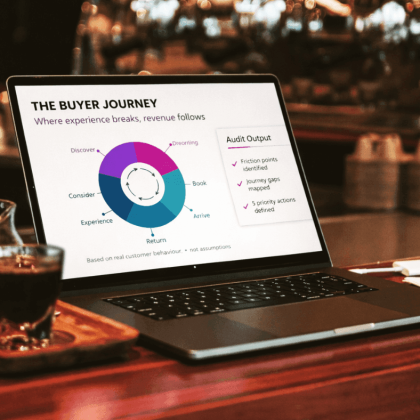
Hospitality Customer Experience Audit
Uncover where guest bookings drop off and where your marketing is causing friction across your physical and digital touchpoints.
- ✓
Bespoke Video Walkthrough: A recorded walkthrough of your guest journey across key contact points. - ✓
Priority Roadmap PDF: Five immediate, high-ROI actions to improve retention and spend. - ✓
7-Day Email Support: Direct Q&A window to assist your team with immediate implementation.
Check whether your business is a fit