
Executive Summary: Key Takeaways
- Protect Margins & Fix Technical Feeds: Prevent festive revenue loss by updating menu and room inventory in real time across Google and third-party listings to avoid algorithmic penalties and costly commissions.
- Stop Paid Ad Budget Waste: Cut wasted marketing spend by tightening geo-targeting, adding strict negative keywords, and pausing broad, automated holiday campaigns.
- Streamline the Booking Journey: Eliminate reservation drop-offs by removing friction, slow mobile loading, and complex steps from the direct checkout process.
December Margin Protection
Commercial margins in modern hospitality are won or lost at the point of distribution. When occupancy peaks during seasonal trading, many boutique hotels and premium restaurant groups assume their revenue pipelines are secure simply because booking volume is high. Yet high gross revenue frequently conceals significant distribution leakage. When guests encounter broken pricing displays, or search engines route traffic through third-party intermediaries taking fifteen to twenty per cent commissions, profitability evaporates.
Protecting your margins requires an uncompromising evaluation of your commercial architecture. Recent platform shifts demonstrate that marketing performance is fundamentally tied to channel governance. With Google ending third-party rate displays across Hotel Ads and demanding direct live price feeds via Google Hotel Centre, properties lacking technical compliance face an immediate visibility cliff.
To maintain commercial control, operators must subject their digital ecosystem to a rigorous hotel digital marketing audit that evaluates technical connectivity, platform compliance, and channel prioritisation.
Eliminating Algorithmic and Feed Vulnerabilities
The termination of third-party rate aggregation within Google Hotel Ads signals a broader industry transition toward verified data feeds. For years, independent operators relied on secondary intermediaries or aggregators to syndicate their availability into search results. Under Google’s updated mandate, that layer of technical abstraction is gone.
If your property management system or booking engine does not maintain an active, verified API integration with Google Hotel Centre, your direct booking link will not appear in the primary travel search panel. Instead, the real estate is ceded entirely to Online Travel Agencies (OTAs), who will gladly sell your inventory back to you at an inflated cost of acquisition.
An internal technical audit must verify your live rate feed integrity. Ensure your connectivity partner pushes real-time rates, tax breakdowns, and room configurations without latency. Discrepancies between your search listing and checkout engine violate platform policies and directly increase booking abandonment.
As highlighted in the December 2026 Strategic Update, maintaining direct feed compliance is no longer a peripheral IT consideration; it is the baseline requirement for direct digital revenue generation.
Controlling Paid Campaign Spend Leakage
The second critical area of commercial leakage occurs within programmatic and automated paid search campaigns. Modern ad networks, particularly Google Ads, have increasingly pushed operators into automated bidding frameworks such as Performance Max and Demand Gen. While powerful, these algorithmic systems naturally gravitate toward the easiest, lowest-cost placements to spend your daily allocation—often shifting high-intent search budgets into low-converting display placements and irrelevant search partner networks.
Google’s recent rollout of channel prioritisation and budget allocation controls provides operators with the defensive levers necessary to halt this bleed. High-performing hospitality marketing requires segmenting branded search terms, non-branded local discovery terms, and seasonal campaigns into strict priority tiers.
Marketing teams must manually designate Search campaigns as high-priority, applying percentage-based spend caps on secondary networks. Doing so ring-fences your budget for guests actively searching for private dining rooms, festive afternoon teas, or holiday suite bookings, ensuring automated algorithms do not divert vital ad capital into decorative vanity impressions.
Mitigating Reputation Freezes and Conversion Bottlenecks
Channel integrity extends beyond advertising networks into your organic conversion mechanisms, specifically reputation management. Reviews form the psychological bedrock of the hospitality booking decision. However, Google Business Profile has updated its automated review protection protocols to curb artificial reputation manipulation. When automated detection algorithms register an abnormal surge in review submissions, the platform initiates a defensive freeze: flagged reviews are purged, and the venue’s profile is barred from receiving new public ratings for several days.
During seasonal peaks, guest turnover spikes dramatically. If your automated guest communication software triggers review requests en masse following check-out, this sudden influx can inadvertently trigger Google’s anti-spam thresholds.
A thorough operational audit assesses your post-stay engagement workflows. Request cadences must be staggered intelligently across your guest database to generate a consistent, natural velocity of customer feedback. A frozen review feed during peak booking weeks damages social proof precisely when undecided holiday planners are evaluating your venue against local competitors.
Conducting the Strategic Channel Review
To ensure your booking architecture is fully insulated against platform volatility, operators must systematically examine their digital pathways:
- Verify live connectivity between your central reservation software and Google Hotel Centre, confirming rate parity across every public tier.
- Audit Google Ads budget distribution, applying negative keyword lists and channel prioritisation caps to prevent spend leakage into display networks.
- Adjust automated guest communication cadences within your CRM to prevent artificial review spikes on Google Business Profile.
- Map your complete mobile checkout flow to identify interface latency, missing local payment methods, or confusing cancellation terms that undermine conversions.
Maintaining a resilient hospitality enterprise requires proactive channel governance rather than reactive troubleshooting during busy service periods. If your internal teams lack the technical bandwidth or specialised diagnostic tools to stress-test these channels, securing an objective, professional review is essential.
DG Consulting • Marketing Audits
Personally reviewed by Dawn Gribble, MCIM MIH
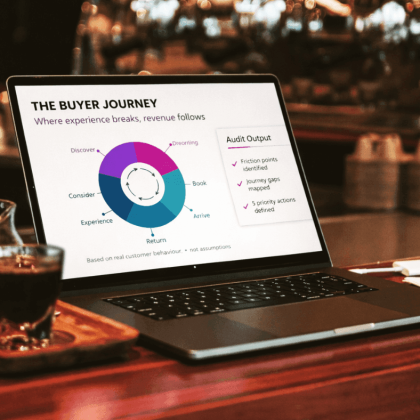
Hospitality Customer Experience Audit
Uncover where guest bookings drop off and where your marketing is causing friction across your physical and digital touchpoints.
- ✓
Bespoke Video Walkthrough: A recorded walkthrough of your guest journey across key contact points. - ✓
Priority Roadmap PDF: Five immediate, high-ROI actions to improve retention and spend. - ✓
7-Day Email Support: Direct Q&A window to assist your team with immediate implementation.
Check whether your business is a fit